
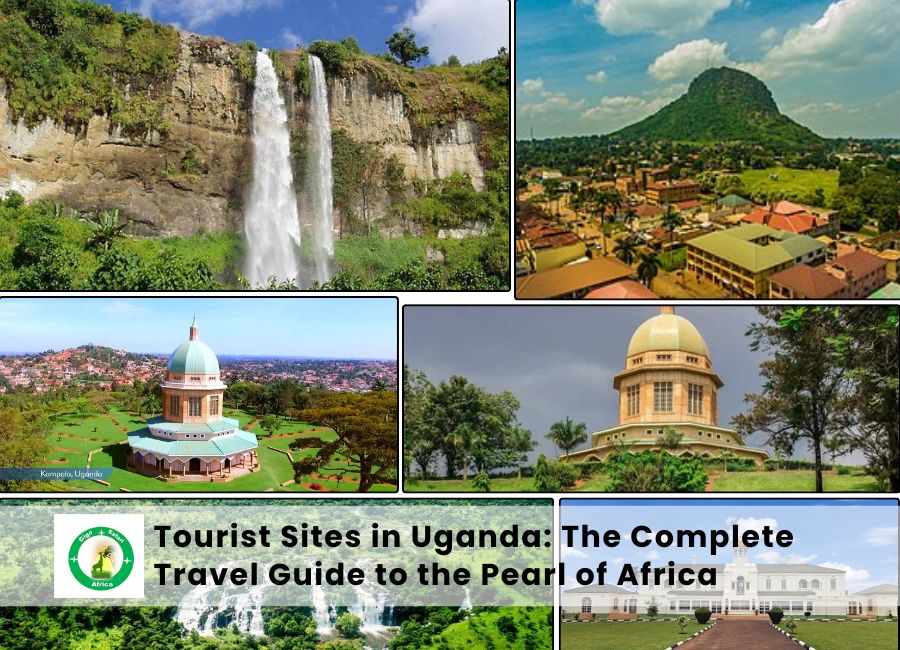
Tourist Sites in Uganda: The Complete Travel Guide to the Pearl of Africa
Uganda sits right on the equator in East Africa, wrapped in ancient forests, thundering rivers, open savannahs, and some of the most diverse wildlife on the planet. Winston Churchill called it the “Pearl of Africa” in 1908, and the name has stuck ever since. Today, Uganda draws travelers from every corner of the world, not just for gorilla trekking, but for everything from whitewater rafting on the Nile to watching tree-climbing lions at sunset. If you are looking for a destination that packs mountain gorillas, big-game safaris, cultural history, and adventure sports into one country, Uganda delivers all of it.
This guide covers every major tourist site in Uganda with real, useful information, where each place is, what you will actually see there, how to get in, and what makes each site worth your travel budget.
Bwindi Impenetrable National Park — Home of the Mountain Gorilla
Bwindi Impenetrable National Park is the single most visited tourist site in Uganda, and it earns that title. Located in the southwestern corner of the country in the Albertine Rift, this ancient rainforest has remained largely unchanged for over 25,000 years. The park sits at elevations between 1,160 and 2,607 meters above sea level, and its name comes from the Rukiga word “Mubwindi,” which translates to “dark, impenetrable place.” The forest lives up to that name — dense, misty, layered, and alive with sound at every hour.
The reason most travelers come to Bwindi is the mountain gorilla. Uganda is home to more than half of the world’s entire mountain gorilla population, and Bwindi alone shelters around 460 of them. The park has over 20 habituated gorilla families spread across four trekking sectors — Buhoma, Ruhija, Rushaga, and Nkuringo — and each sector offers a different landscape and level of difficulty. Buhoma is the most established and accessible, making it the go-to choice for first-time trekkers. Rushaga, in the south, is the only sector offering the Gorilla Habituation Experience, where visitors spend up to four hours with a semi-habituated family alongside researchers.
A standard gorilla trekking permit costs $800 USD per person for foreign non-residents, $700 for foreign residents living in Uganda, and UGX 300,000 for East African citizens. Only 8 visitors per gorilla family per day are allowed, which keeps the experience intimate and protects the animals. The permit includes park entry, a professional ranger guide, a community levy, and a trekking certificate. Once you find the gorilla family, which can take anywhere from 1 to 6 hours through steep, muddy forest, you spend exactly one hour with them at a minimum distance of 7 meters. The experience of watching a silverback move through the forest, or seeing a mother gorilla nurse her infant a few meters away, is something travelers consistently describe as the most powerful wildlife encounter of their lives.
Beyond gorillas, Bwindi holds over 350 bird species, 120 mammal species, and the forest itself — ancient, cathedral-like, and full of tree ferns, giant mahogany trees, and colobus monkeys moving through the canopy overhead. The Batwa Forest Experience is a cultural add-on that introduces visitors to the indigenous Batwa community, who originally lived within the forest before it became a protected area.
Bwindi is a UNESCO World Heritage Site. Permits sell out 3 to 6 months in advance during peak season (June to September and December to February), so book early.
Murchison Falls National Park — Where the Nile Explodes Through Rock
Murchison Falls National Park is Uganda’s largest national park, covering 3,893 square kilometers in the northwest of the country. The park sits within the larger Murchison Falls Conservation Area, which includes Bugungu and Karuma Wildlife Reserves. It was declared a national park in 1952 and is also Uganda’s oldest protected area.
The centerpiece is the waterfall itself. At Murchison Falls, the entire volume of the Victoria Nile — Africa’s greatest river — is forced through a rocky gap just 7 meters wide before plunging 43 meters into a churning pool below known as the Devil’s Cauldron. The force produced is extraordinary: approximately 300 cubic meters of water per second compressed through that narrow channel, creating one of the most powerful waterfalls on earth and one of the Seven Natural Wonders of Africa. Standing at the top of the falls and watching the river detonate through the gap is one of Uganda’s defining travel moments.
The park’s wildlife is equally impressive. It hosts over 76 mammal species, including lions, elephants, leopards, buffaloes, giraffes, hippos, crocodiles, and Uganda kob. Murchison is the world’s most important habitat for Rothschild’s giraffe, a critically endangered subspecies often seen moving in herds across the open savannah. Rhinos are absent from the park itself but can be tracked at nearby Ziwa Rhino Sanctuary, the only place in Uganda where wild white rhinos live — making it a logical stop on the drive from Kampala.
The Nile boat cruise from Paraa to the base of the falls is one of the most-recommended activities in all of East Africa. The three-hour return journey takes you along a stretch of river teeming with hippos on the banks, Nile crocodiles sunning themselves on sandbanks, elephants drinking at the water’s edge, and over 450 bird species overhead — including the rare shoebill stork, which Murchison hosts in one of its most accessible populations anywhere. The bird count of 450 species makes Murchison Falls one of Uganda’s top birding destinations.
Game drives on the north bank of the Nile reveal rolling grasslands dotted with borassus palms, and wildlife density here is among the highest in Uganda. Chimpanzee trekking is available in the adjoining Budongo Forest, home to around 800 chimpanzees including several habituated groups. The park is approximately 305 kilometers north of Kampala, about a 4.5-hour drive via the Kampala–Masindi highway. Charter flights from Kajjansi airstrip near Entebbe fly directly to Chobe Airstrip inside the park in about 90 minutes.
Park entry is $40 per day for international visitors. A budget 3-day safari starts from around $450 per person, with mid-range packages running $600 to $900 and luxury lodge safaris from $1,200 per person.
Queen Elizabeth National Park — Big Game and Tree-Climbing Lions
Queen Elizabeth National Park is Uganda’s most popular safari destination and the country’s most ecologically diverse protected area. Covering 1,978 square kilometers in the southwest, the park stretches from the Rwenzori Mountains in the north to the border with the Democratic Republic of Congo in the south. It sits on the equator, which means the landscape inside the park includes savannah, tropical forest, crater lakes, wetlands, and the Kazinga Channel — a 40-kilometer natural waterway connecting Lake George and Lake Edward.
The park’s wildlife is remarkable in its variety. Elephants, buffaloes, leopards, hippos, warthogs, and over 100 mammal species live here, but the feature that draws the most attention is the tree-climbing lions of the Ishasha sector in the south. Unlike most lions, which rest on the ground, the Ishasha prides have developed the habit of climbing into fig and sycamore trees, where they drape themselves across branches in the afternoon heat. This behavior is rare globally and almost nowhere else in Africa can you see lions doing this in their wild habitat.
The Kazinga Channel boat cruise is Queen Elizabeth’s equivalent of Murchison’s Nile cruise — a slow, guided journey along the water’s edge where hippos, crocodiles, elephants, and buffalo gather in remarkable density. With a recorded 600 bird species, Queen Elizabeth National Park ranks among the world’s premier birdwatching destinations, and the Kazinga Channel alone offers extraordinary birding. Birds to look for include the African skimmer, pied kingfisher, malachite kingfisher, and various herons and egrets.
The Kyambura Gorge on the park’s eastern edge is a forested valley carved deep into the savannah landscape, home to a habituated chimpanzee community that can be tracked on guided walks. The contrast between the open grassland above and the dense riverine forest inside the gorge is visually striking and the chimpanzee encounters here are intimate, with far fewer visitors than Kibale Forest.
Kibale National Park — The Primate Capital of the World
Kibale National Park in western Uganda holds the highest density of primates of any habitat on earth. The park is home to 13 different primate species, including red colobus monkeys, black-and-white colobus, grey-cheeked mangabeys, olive baboons, and the L’Hoest’s monkey. The star attraction is chimpanzees, with Kibale hosting one of the largest and best-habituated chimpanzee populations in Africa — estimated at around 1,500 individuals across the park, with several habituated groups available for trekking.
Chimpanzee trekking in Kibale starts early in the morning at Kanyachu Visitor Centre. Groups of no more than 6 people are accompanied by an experienced ranger guide into the forest, where the habituated chimpanzee communities move through their daily routines. The success rate for finding chimpanzees in Kibale is very high — well above 90% on most days — and because the animals are so accustomed to human presence, they go about their business naturally. Watching a chimpanzee crack open a nut with a stone, or seeing two adults groom each other in a shaft of forest light, produces the same sense of kinship with our evolutionary family that gorilla trekking does.
The Bigodi Wetland Sanctuary, a community-managed wetland just outside the park, offers excellent birding and primate watching at a fraction of the cost of the main park, and the money goes directly to local communities. Fort Portal town, close to Kibale, is one of Uganda’s most pleasant small cities and serves as a base for exploring the crater lakes of the Tooro region — a landscape of over 52 volcanic craters many of which have filled with deep, blue water surrounded by tea plantations and forest.
Jinja — The Source of the Nile and Adventure Capital of East Africa
Jinja sits 80 kilometers east of Kampala on the northern shore of Lake Victoria. It is the town where the Nile River begins its 6,600-kilometer journey from Africa’s largest freshwater lake northward through Uganda, South Sudan, Sudan, and Egypt to the Mediterranean Sea. The geographical and historical significance of the site drew explorers to Uganda for decades in the 19th century, and the quest to find the source of the Nile was one of the great geographical mysteries of its era.
British explorer John Hanning Speke reached the northern end of Lake Victoria in 1858 and identified it as the primary source of the Nile, naming the lake after Queen Victoria. He returned in 1862 to confirm his findings at the point now known as Jinja. The Speke Monument still stands at the site today. A short distance away is a monument to Mahatma Gandhi — according to his wishes, part of Gandhi’s ashes were scattered in the Nile at Jinja after his death in 1948, reflecting the historical connection between Indian communities and Uganda during the colonial period.
Today Jinja is equally famous as East Africa’s adventure capital. The Nile through Jinja runs through a series of world-class rapids, and whitewater rafting here is considered among the best in the world. The rapids range from Grade 3 for families and beginners to Grade 5 for serious adrenaline seekers. Beyond rafting, Jinja offers kayaking, bungee jumping from a 44-meter platform above the Nile, quad biking, horse riding, stand-up paddleboarding, and sunset boat cruises on Lake Bujagali. Birdwatchers find the riparian woodland exceptional, with kingfishers, fish eagles, rock pratincoles, and the papyrus gonolek easily spotted along the river banks.
Jinja is roughly a 2-hour drive from Kampala and works well as either a day trip or an overnight stop before or after a longer Uganda safari.
Kidepo Valley National Park — Uganda’s Remote Wilderness Gem
Kidepo Valley National Park occupies the northeastern corner of Uganda, bordering both South Sudan and Kenya in the Karamoja region. It is Uganda’s most isolated national park, which means it sees far fewer visitors than the parks in the west and south, a fact that many travelers regard as its greatest asset. The scenery here is semi-arid and dramatic, with wide open valleys, ancient mountains, and skies that stretch to every horizon without a building or power line in sight.
Kidepo holds the most diverse mammal species count of any Ugandan park. It is the only park in Uganda where cheetahs have been recorded, and it also harbors caracals, striped hyenas, aardvarks, and the bat-eared fox — species absent from other Ugandan parks. Lions, elephants, buffaloes, zebras, giraffes, and ostriches round out a wildlife list of over 77 mammal species. The Narus Valley, which retains water year-round, draws animals in extraordinary concentrations during the dry season when other parts of the park dry out.
The birdlife is exceptional even by Ugandan standards, over 475 species have been recorded, making Kidepo one of the top birding destinations on the African continent. Kidepo is most easily reached by charter flight from Entebbe, which takes about 2 hours. Road trips from Kampala take approximately 10 hours. The Karamojong people who live around the park have a rich pastoral culture, and cultural tours to Uganda and their communities are among the most authentic in Uganda.
Rwenzori Mountains National Park — The Mountains of the Moon
The Rwenzori Mountains form the natural border between Uganda and the Democratic Republic of Congo and rise to peaks permanently capped in snow and glacier ice despite sitting just north of the equator. The highest peak, Margherita on Mount Stanley, reaches 5,109 meters, the third-highest point in Africa. The ancient Greek geographer Ptolemy referred to snowcapped mountains in equatorial Africa as the “Mountains of the Moon,” a name that survives to this day. The Rwenzoris are a UNESCO World Heritage Site.
Trekking through the Rwenzori Mountains is one of Uganda’s most demanding and rewarding adventures. The trails pass through several distinct vegetation zones — montane forest, bamboo, heather moorland, and finally alpine zones with giant lobelias and senecio plants that grow to tree height in the cold mist. The full circuit to the summit glaciers takes about 8 to 12 days, but shorter treks of 3 to 5 days are available for those who want to experience the forest and moorland zones without attempting the summit.
Wildlife in the park includes forest elephants, chimpanzees, colobus monkeys, and over 200 bird species, including the rare Rwenzori turaco. The mountain range generates its own weather system, which means cloud and mist are common year-round. The driest months — January to February and June to August — give the best summit conditions.
Mgahinga Gorilla National Park — Gorillas and Golden Monkeys
Mgahinga Gorilla National Park sits in the extreme southwest of Uganda where the borders of Uganda, Rwanda, and the Democratic Republic of Congo meet. The park is the smallest of Uganda’s national parks, covering just 33.9 square kilometers, but it holds one habituated mountain gorilla family — the Nyakagezi family — and one of Uganda’s most underrated wildlife encounters: golden monkey trekking.
The golden monkey is a beautiful, rare primate found only in the Virunga volcanic mountains that straddle the three-country border. With its bright orange-gold back contrasting with black limbs, it is one of the most visually striking primates in Africa. The habituated golden monkey group in Mgahinga can be tracked on guided morning treks, and the combination of gorilla trekking in Uganda and golden monkey trekking in the same park makes Mgahinga an efficient choice for travelers wanting both experiences.
The park’s three volcanoes, Muhavura (4,127m), Gahinga (3,474m), and Sabinyo (3,645m) — are also hikeable, with Mount Sabinyo offering the unique experience of standing in three countries simultaneously at its summit crater rim.
Kampala — Uganda’s Capital and Cultural Heart
Kampala is Uganda’s capital and largest city, spread across seven hills on the northern shore of Lake Victoria. It serves as the entry point for most visitors, with Entebbe International Airport located 35 kilometers away on the lake shore. While many travelers pass through Kampala quickly on their way to the national parks, the city rewards those who take a day or two to explore it properly.
The Kasubi Tombs are Kampala’s most culturally significant site — a UNESCO World Heritage Site and the burial ground of four Kabaka (kings) of the Buganda Kingdom. The main structure, Muzibu Azaala Mpanga, is a massive thatched building constructed entirely from organic materials, including bark cloth, reeds, and wicker, and represents one of the finest examples of Buganda architecture in existence. The Uganda Museum on Kira Road holds the country’s most comprehensive collection of cultural artifacts, from Stone Age tools to traditional musical instruments and reconstructed homesteads of different Ugandan ethnic groups. The Gaddafi National Mosque, officially the Uganda National Mosque, is the largest mosque in Uganda and one of the largest in sub-Saharan Africa, built with funding from the Libyan government in the 1970s and completed in 2008. Non-Muslim visitors can climb the minaret for panoramic views of the city. The Ndere Cultural Centre offers weekly performances of traditional music, dance, and storytelling from Uganda’s 56 ethnic groups.
Owino Market (St Balikuddembe Market) is the largest market in East Africa, with thousands of stalls selling everything from fresh produce and second-hand clothing to electronics and traditional herbs. Shopping here is a sensory experience that gives a clear picture of daily urban Ugandan life.
Lake Mburo National Park — The Closest Safari to Kampala
Lake Mburo National Park is the smallest national park in Uganda and the one nearest to Kampala — just 240 kilometers southwest of the capital, making it a practical stop for travelers on the way to or from the national parks of the west and southwest. The park covers 370 square kilometers and centers on a system of five lakes connected by swampy valleys.
What sets Lake Mburo apart from Uganda’s other parks is the range of activities available on foot and by bike. Guided walking safaris are possible here because the park has no lions, meaning visitors can walk among zebras, elands, and topi without the risk factors of other parks. Cycling through the park on guided bike safaris is another option, and night game drives reveal nocturnal animals including leopards, civets, and porcupines that are rarely seen elsewhere. The lake itself offers boat cruises past hippos and crocodiles, and the surrounding wetland is excellent for birdwatching, with African finfoot, papyrus yellow warbler, and the red-faced barbet among the sought-after species.
Lake Mburo is also the easiest place in Uganda to see zebras and impalas — neither of which lives in Uganda’s western parks.
Sipi Falls — Eastern Uganda’s Hidden Natural Treasure
Sipi Falls is a series of three waterfalls on the western slopes of Mount Elgon in eastern Uganda, near the town of Kapchorwa. The falls drop in stages through lush highland farmland, with the main cascade plunging 100 meters into a misty pool surrounded by banana plantations and coffee farms. The area is home to the Sabiny (Sebei) people, who have farmed these slopes for generations, and the combination of natural scenery and cultural depth makes Sipi one of Uganda’s most rewarding short detours.
The most popular activity is abseiling the falls, a guided descent alongside the main waterfall on ropes, giving a close-up view of the cascading water and the surrounding valley. Guided walks to all three falls take about 3 to 4 hours round-trip. Coffee tours are a local specialty, where visitors follow the bean from the red cherry on the plant through washing, fermenting, drying, and roasting to the cup. Uganda produces some of the finest Arabica coffee in the world, and the highlands around Sipi are among the premier growing areas.
Sipi is about 230 kilometers from Kampala, roughly a 5-hour drive via Mbale.
Semuliki National Park — Uganda’s Lowland Rainforest Frontier
Semuliki National Park in western Uganda is the country’s most biogeographically unusual protected area. The park protects the eastern edge of the Ituri Forest, the vast lowland rainforest of the Congo Basin that extends westward across Central Africa, making it the only place in East Africa where visitors can experience this type of forest. The result is a park that feels entirely different from Uganda’s other forests, flatter, steamier, and full of species that exist nowhere else on the eastern side of the continent.
The park’s hot springs at Sempaya are a dramatic geological feature — boiling water erupts from the ground in two locations called “the female spring” and “the male spring,” the latter shooting a jet of near-boiling water several meters into the air. The surrounding mudflats are colored in ochre and white mineral deposits. Birdwatching in Semuliki is exceptional, with 441 recorded species, including 58 species not found elsewhere in Uganda — the park contributes more unique bird species to Uganda’s national list than any other single protected area. The African piculet, Congo serpent-eagle, and the rare lyre-tailed honeyguide are among the target species for visiting birders.
Lake Bunyonyi — Uganda’s Most Scenic Lake
Lake Bunyonyi sits in the far southwest of Uganda near Kabale, close to the border with Rwanda, and is consistently described as one of the most beautiful lakes in Africa. The name means “place of many little birds” in the local language, and the lake is indeed rich in birdlife, but it is the scenery that draws most visitors. Thirty-two islands dot the deeply indented shoreline, surrounded by terraced hillsides of banana and sorghum that descend steeply to the water’s edge. The landscape has a quality of quiet, layered beauty that rewards slow travel.
The lake is one of the few large bodies of water in Africa that is safe for swimming, it is free of crocodiles, hippos, and bilharzia. Dugout canoe trips around the islands are the most popular activity. Punishment Island is a historically significant site: in the not-too-distant past, unmarried girls who became pregnant were left there to starve as community punishment. The island is now a place of reflection and education. Bwama Island holds a school and has been a site of community development for decades.
Lake Bunyonyi is commonly visited as a relaxing endpoint after gorilla trekking in nearby Bwindi, a place to decompress after the physical demands of trekking before the journey back to Kampala or onward to Rwanda.
Practical Travel Information for Uganda
When to visit: Uganda’s best wildlife viewing is during the dry seasons, December to February and June to August. Gorilla trekking is possible year-round, but is physically easier on dry trails. The wet seasons (March to May and October to November) bring lush green scenery, lower accommodation prices, fewer visitors, and excellent birding as migratory species arrive.
Getting there: Entebbe International Airport serves Kampala and is the gateway for all international arrivals. Major carriers, including Kenya Airways, Ethiopian Airlines, and Qatar Airways, connect Uganda to global destinations. From the airport to Kampala is about 35 kilometers.
Visas: Most nationalities can obtain a tourist visa on arrival at Entebbe Airport or in advance through the Uganda e-visa portal. The East Africa Tourist Visa covers Uganda, Kenya, and Rwanda with a single $100 visa.
Health: Malaria is present in Uganda. Travelers should take antimalarial medication and use insect repellent. Yellow fever vaccination is required for entry. Other recommended vaccinations include typhoid, hepatitis A, and rabies for those spending significant time in rural areas.
Currency: The Ugandan Shilling (UGX) is the local currency. US dollars are widely accepted for tourism-related payments. ATMs are available in Kampala and major towns.
Getting around: Hiring a private 4WD vehicle with a driver-guide is the most practical way to travel between national parks. Self-drive is possible but requires confidence on unpaved roads. Domestic charter flights save significant travel time between distant parks.
Minimum trip length: Allow at least 7 days to cover the highlights. A 10 to 14-day itinerary gives enough time to combine gorilla trekking in Bwindi, chimpanzee trekking in Kibale, a wildlife African safari tour in either Murchison Falls or Queen Elizabeth, and a day or two in Jinja and Kampala.
Why Uganda Stands Apart from Other African Safari Destinations
Uganda is not a destination you visit to replace another African country on a list. It is a destination you visit because it offers things no other country does in quite the same way. You can stand face-to-face with a mountain gorilla in the morning, watch the world’s longest river explode through a gap in the rock in the afternoon, and fall asleep to the sound of a rainforest at night. The wildlife density is extraordinary, the forests are ancient and alive, and the country’s 56 ethnic groups each bring distinct cultural traditions, music, food, and history into the experience.
Uganda is also, by African wildlife destination standards, excellent value. A gorilla trekking permit at $800 is half the price of Rwanda’s $1,500, and the overall cost of a Uganda safari is significantly lower than Tanzania or Kenya for comparable wildlife quality. The country has grown steadily as a travel destination over the past decade, and infrastructure — roads, lodges, airstrips — has improved considerably, though the parks remain far less crowded than their counterparts elsewhere on the continent.
The Pearl of Africa is waiting.

Recent Posts
Mgahinga Gorilla National Park
Rwenzori Mountains Uganda: The Mountains of the Moon
The Shoebill Stork in Uganda: A Bird Watcher’s Complete Tour Guide

