
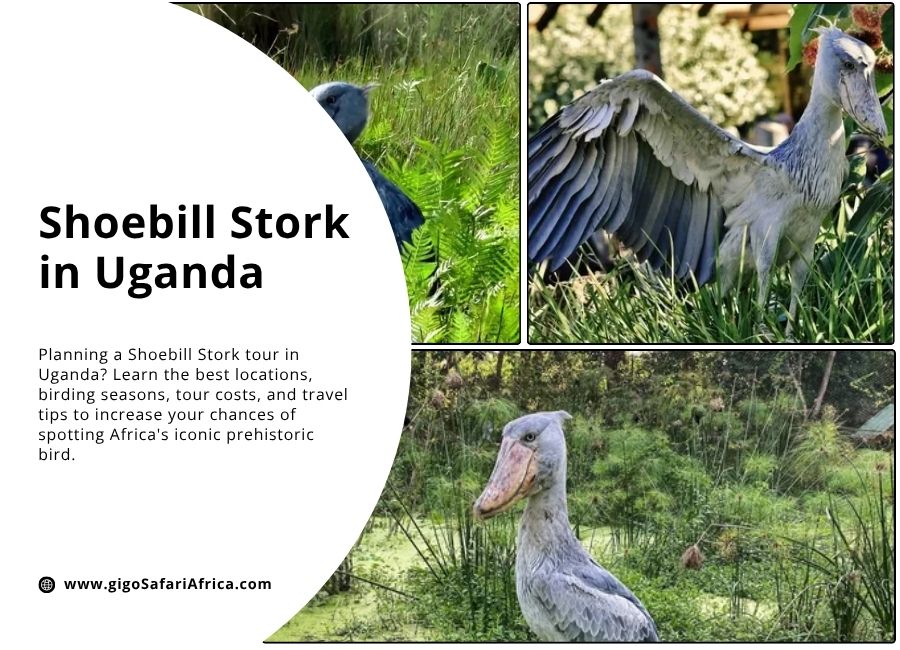
The Shoebill Stork in Uganda: A Bird Watcher’s Complete Tour Guide
Uganda holds one of the world’s most significant populations of the shoebill stork (Balaeniceps rex). Across nine distinct wetland sites, from the shores of Lake Victoria to the Nile Delta, this is the most reliable country on earth to find one.
The shoebill stands up to five feet tall and moves through papyrus swamps with a patience that has earned it the nickname “statue bird.” It is solitary, non-migratory, and listed as Vulnerable on the IUCN Red List with fewer than 5,300 mature individuals estimated to remain globally. Uganda accounts for a substantial share of that number. That combination of rarity, physical presence, and the raw wildness of the wetland habitats makes tracking it one of the most sought-after experiences in African birding.
This guide covers every location we visit on our shoebill tracking tours in Uganda, the best windows of the year to book, and exactly what to expect when you’re gliding through the reeds on a traditional canoe at first light.
Where We Take You: Our Shoebill Tour Locations
Our African Safari tours access nine tracked habitats across Uganda. Below are the six locations we prioritize based on sighting success rates, habitat quality, and overall safari experience.
Mabamba Swamp (Lake Victoria)
The most reliable shoebill site in all of Africa. A RAMSAR-designated wetland on Lake Victoria’s northern shore, approximately 12 km west of Entebbe. Guests arrive by speedboat from Nakiwogo Landing Site or by road via Kasanje.
- Traditional canoe excursion through papyrus channels
- Over 300 resident bird species, including Papyrus Gonolek and African Fish Eagle
- Community-guided by MWETA local expert birders
- Perfect day trip from Entebbe or Kampala (4–6 hours total)
Murchison Falls NP (Nile Delta)
Best Multi-Day
The Albert Delta, where the Nile splits into Lake Albert and the Albert Nile, is Uganda’s second-most productive shoebill site. Boat safaris at dawn through wide-open water channels and papyrus floodplains set this apart from any other birding experience.
- Combined with game drives and the iconic Murchison Falls viewpoint
- Budongo Forest Reserve birding available as an add-on
- Easily combined with Lugogo Swamp and Ziwa Rhino Sanctuary
Lugogo Swamp (Ziwa Rhino Sanctuary)
Combo Tour
Accessible through Ziwa Rhino Sanctuary, Lugogo Swamp pairs shoebill tracking with rhino tracking in a single day. A rare combination that no other East African destination offers.
- Uganda’s only wild rhino population on site
- Excellent for birders who want a varied one-day itinerary
- Midpoint between Kampala and Murchison Falls, ideal stopovers
Queen Elizabeth NP (Kazinga Channel)
Wildlife Safari Tours in Uganda
The Kazinga Channel and Ishasha Sector wetlands host shoebills alongside elephants, hippos, and the famous tree-climbing lions. Boat safaris on the Kazinga Channel are the most effective method here.
- Ishasha Sector: remote, uncrowded shoebill marsh habitats
- Wet season sightings particularly strong in the Kazinga Channel
- Pairs naturally with a Bwindi gorilla trekking extension
Toro-Semuliki Wildlife Reserve
400+ Species
Uganda’s dedicated bird sanctuary in southwestern Uganda, accessed from Fort Portal. Over 400 bird species make this a full birding destination in its own right, with the shoebill as a key target.
- March is the peak month, post-dry season, and active breeding time
- Combines well with Kibale National Park chimpanzee tracking
- Less visited than Mabamba, excellent for experienced birders
Makanaga Swamp (Masaka Road)
Off the Beaten Track
Roughly 60 km from Entebbe, Makanaga is less visited than Mabamba and preferred by serious birders who want an uncrowded, intimate wetland experience. Accessed via Kamengo trading centre on the Kampala-Masaka road.
- No large tour groups, undisturbed shoebill habitat
- Strong choice for repeat Uganda visitors
- Also accessible: Nabajuzi Swamp and Lwera Swamp on Western Uganda routes
Why Mabamba Swamp matters beyond birdwatching: Mabamba Bay was designated an Important Bird Area in 2001 and a RAMSAR wetland site in 2006. The Mabamba Wetland Eco-tourism Association (MWETA), a community group of local fishermen, bird guides, and craftswomen, manages access and conservation on the ground. Every canoe tour you book directly funds their work.
When to Go: Shoebill Sighting Windows by Season
Shoebill tracking is possible throughout the year in Uganda. The bird is non-migratory. That said, water levels, vegetation density, and bird activity patterns shift significantly by season, and those shifts determine your chances of a close sighting.
| Period | Months | Conditions | Rating |
| Dry Season 1 | June – August | Low water levels, clear sightlines, calm mornings, shoebills venture to open feeding areas | Best |
| Dry Season 2 | December – February | Excellent visibility, easier canoe navigation, breeding activity in some sites | Best |
| Shoulder | March, September | Transition months — often less crowded, some March site-specific breeding activity | Good |
| Wet Season | April – May, Oct – Nov | Higher water forces shoebills deeper into vegetation; still trackable with covered canoes | Moderate |
Within any season, time of day matters most at Mabamba. Early morning excursions between 6:00 AM and 10:00 AM carry close to a 99% sighting probability when water conditions are calm. The shoebill hunts at this hour, standing motionless in shallow water, waiting on lungfish and tilapia, and is far more visible than during midday when it retreats to shaded papyrus. Afternoon tours from around 4:00 PM onward are our second-best window.
What Our Tours Include
Across all our shoebill tour departures, guests travel by traditional dugout canoe or motorized canoe guided by locally trained naturalists who know these wetlands intimately. Here is the standard structure of a day tour from Entebbe or Kampala to Mabamba Swamp, our most popular departure:
- Early morning hotel pick-up in Entebbe or Kampala. Transfer to Nakiwogo Landing Site.
- 45-minute scenic speedboat crossing of Lake Victoria to Mabamba Swamp, waterbirds visible en route.
- Canoe launch into the papyrus channels with a local expert guide who tracks active shoebill territories.
- Two to three hours on the water, calm, quiet, close-proximity observation and photography.
- Return to Entebbe. Optional extension: equator monument visit or Lake Victoria beach.
All standard day tours include round-trip transport, park and wetland entry fees, the canoe and paddler, your certified bird guide, and bottled water. Multi-day itineraries visiting Murchison Falls, Queen Elizabeth, and Toro-Semuliki are fully custom-built around your schedule and target species list.
Conservation Status & Why Uganda Is the Right Place to See It
The IUCN Red List classifies the shoebill as Vulnerable, with an estimated 3,300 to 5,300 mature individuals remaining across Central and East Africa. Uganda holds approximately 1,000 of those, a significant concentration relative to its land area. The primary threats are wetland drainage for agriculture, disturbance during breeding seasons, and illegal capture for the exotic pet trade, where a single live bird can command tens of thousands of dollars on the black market.
Responsible ecotourism in Uganda, specifically the kind that routes revenue directly to community associations like MWETA at Mabamba Bay, is one of the most effective counter-measures. When local fishing communities derive higher income from guiding birders than from the alternative, they become the habitat’s most committed protectors. Uganda Wildlife Authority (UWA) actively monitors key shoebill territories and partners with community organizations on sustained conservation programs across all nine tracked sites.

Recent Posts
Mgahinga Gorilla National Park
Rwenzori Mountains Uganda: The Mountains of the Moon
The Shoebill Stork in Uganda: A Bird Watcher’s Complete Tour Guide

