
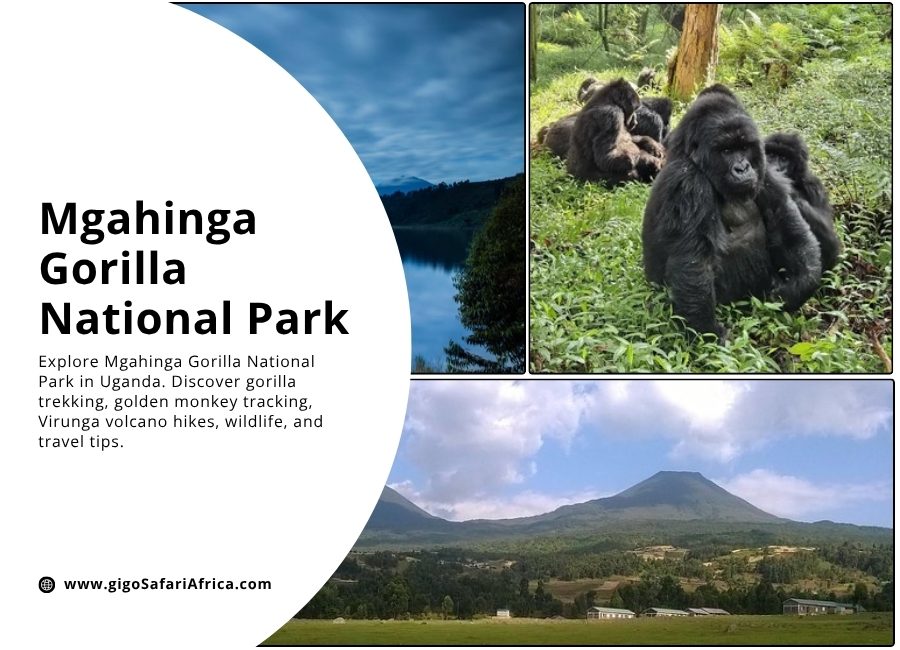
Mgahinga Gorilla National Park
When travellers search for Volcanoes National Park in Uganda, they are looking for Mgahinga Gorilla National Park, Uganda’s entry point into the Virunga volcanic chain. It is a small park by African standards, covering just 33.9 km², but what it holds inside is extraordinary: three hikeable volcanoes, the endangered Uganda gorilla trekking experience, the rare golden monkey, and one of the most intact indigenous cultural traditions in East Africa.
| Park Area | 33.9 km² |
| Virunga Volcanoes | 3 |
| Mount Muhabura Altitude | 4,127m |
| Bird Species Recorded | 180+ |
| Year Gazetted | 1991 |
| Gorilla Permit (USD) | $700 |
Where is Mgahinga Gorilla National Park?
Mgahinga sits in the far southwestern corner of Uganda, in Kisoro District, roughly 540 kilometres from Kampala. The park shares its southern border with Rwanda’s Volcanoes National Park and its western edge with the Democratic Republic of Congo’s Virunga National Park.
Together, these three protected areas form the Virunga Conservation Area, a transboundary ecosystem recognised as one of the most important biodiversity corridors in Africa. The park headquarters at Ntebeko is the main gateway for all activities.
From Kisoro town, the park entrance is about 10 kilometres. From Kigali, Rwanda, the crossing via the Cyanika border is roughly a 2 to 2.5-hour drive, making Mgahinga a natural extension for Rwanda-Uganda combination safaris.
The Three Virunga Volcanoes of Mgahinga
The Virunga Massif is a chain of eight volcanoes stretching across Uganda, Rwanda, and the DRC. Three of them rise inside Mgahinga’s boundaries. Hiking any one of them is a full-day guided commitment through montane forest, bamboo zones, and afro-alpine terrain.
| Volcano | Altitude | Trek Duration | Notable Feature |
|---|---|---|---|
| Mount Muhabura | 4,127m | ~10 hours | Highest peak in the park; panoramic views over the entire Virunga massif and Lake Edward |
| Mount Sabyinyo | 3,645m | ~8 hours | Jagged summit ridge where Uganda, Rwanda, and the DRC converge — three countries, one step |
| Mount Gahinga | 3,474m | ~6 hours | The gentlest climb; leads through bamboo forest to a crater swamp at the top |
All three hikes depart from the park headquarters with a certified guide. Mount Gahinga is the most accessible for trekkers without prior high-altitude experience. Mount Sabyinyo draws serious hikers for its ridgeline scramble and the rare chance to stand at the tri-border point of three nations simultaneously.
Gorilla Trekking in Mgahinga
Mountain gorillas exist in only two places on earth: the Virunga Mountains spanning Uganda, Rwanda, and the DRC, and Uganda’s Bwindi Impenetrable Forest. Mgahinga’s share of that population centres on the Nyakagezi gorilla family — the park’s sole habituated group and the only one open to tourism here.
Treks depart at 08:00 after a briefing at Ntebeko Visitor Centre. The duration depends entirely on where the gorillas have moved overnight. Some treks reach the family within two hours; others take longer through steep bamboo terrain. Once located, visitors spend one hour with the gorillas, which is a firm conservation rule enforced across all Virunga parks.
The Nyakagezi family has a history of occasionally crossing into Rwanda’s National Park and back. If the family crosses before your scheduled trek, Uganda Wildlife Authority will coordinate the transfer. Permits remain valid.
What to expect on the trail
Trails ascend through several distinct vegetation zones. Lower slopes are covered in montane forest; the bamboo belt follows as you gain altitude. The terrain is steep and the trail can be slippery in wet months. Sturdy hiking boots, long sleeves, and garden gloves are standard kit. A porter is available to hire at the park gate — worth considering on any full-day trek.
Golden Monkey Tracking
The golden monkey (Cercopithecus kandti) is an Albertine Rift endemic found in only two places in the world: Mgahinga Gorilla National Park and Rwanda’s Park. The species takes its name from the striking orange-gold patches across its back and flanks.
A habituated troop lives in Mgahinga’s bamboo forest zones. Tracking sessions begin at 08:00 and typically last between 30 minutes and three hours, depending on where the troop forages that day. The experience is noticeably less physically demanding than gorilla trekking, which makes it a good activity to combine on a rest day between volcano hikes.
Uganda golden monkey tracking permits are issued through Uganda Wildlife Authority and are separate from gorilla trekking permits. Many visitors combine both activities across consecutive days.
Batwa Cultural Experience
Before Mgahinga was gazetted as a national park in 1991, the Batwa people — an indigenous hunter-gatherer community — lived inside the forest as they had for generations. The creation of the park displaced them from their ancestral land.
Today, the Batwa Cultural Trail provides a structured way to engage with this history directly. Led by a Batwa guide, the trail walks through the forest and demonstrates traditional practices: honey harvesting, medicinal plant knowledge, hunting techniques, and ritual ceremonies. The trail concludes at Garama Cave, a 200-metre sacred cavern 4 kilometres from the Ntebeko Visitor Centre that once served as a shelter and ceremonial site.
The trail runs in two variations. A shorter three-hour version departs from Ntebeko Gate. A longer seven-hour trail starts from Muhabura Gate. Both include the Garama Cave visit. The permit fee, USD $80 for foreign non-residents, is directed toward Batwa community welfare programs.
Birdwatching in Mgahinga
Despite its compact size, Mgahinga records over 180 bird species, with a strong concentration of Albertine Rift endemics. The park’s vertical diversity makes it one of the best spots for bird watching tours in Uganda
Key species include the Rwenzori Batis, handsome francolin, Archer’s ground robin, regal sunbird, blue-headed sunbird, scarlet-tufted malachite sunbird, and the crowned crane. The gorge trail between Gahinga and Sabyinyo, the bamboo belt, and the higher montane forest sections are the most productive birdwatching zones.
Activities at a Glance
| Activity | Details |
|---|---|
| Gorilla Trekking | Nyakagezi family. One hour with the gorillas. Permits via Uganda Wildlife Authority, USD $700. |
| Golden Monkey Tracking | Habituated troop in bamboo forest. 30 minutes to 3 hours. An Albertine Rift exclusive. |
| Volcano Hiking | Three Virunga peaks: Muhabura, Sabyinyo, Gahinga. Full-day guided hikes from park headquarters. |
| Batwa Trail | Indigenous forest culture, traditional skills, and Garama Cave. USD $80, two route lengths. |
| Birdwatching | Over 180 species including Albertine Rift endemics. Best in bamboo and montane forest zones. |
| Nature Walks | Guided walks through forest trails with views of the volcanic peaks and Lake Mutanda nearby. |
Permits and Fees
All permits for Mgahinga activities are issued by the Uganda Wildlife Authority. Book gorilla permits well in advance — Mgahinga issues a limited number daily.
| Permit | Price |
|---|---|
| Gorilla Trekking Permit (Foreign Non-Resident) | USD $700 |
| Golden Monkey Tracking Permit | Enquire UWA |
| Batwa Cultural Trail (Foreign Non-Resident) | USD $80 |
| Volcano Hiking (per peak) | Enquire UWA |
Mgahinga vs Volcanoes National Park Rwanda
Because Mgahinga and Rwanda’s Volcanoes National Park share the same volcanic mountain range and the same gorilla population, travellers frequently compare the two. They are different experiences.
| Uganda | Rwanda |
|---|---|
| Mgahinga Gorilla National Park | Volcanoes National Park |
| Permit costs USD $700. One habituated gorilla family. Smaller, quieter park with fewer daily visitors. Easier to combine with Bwindi or a Rwanda crossing. More rugged, less tourist infrastructure. Also offers three hikeable volcanoes and golden monkey tracking. | Permit costs USD $1,500. Twelve habituated gorilla families. Well-developed infrastructure, luxury lodge options, 2.5 hours from Kigali. More open bamboo terrain, slightly easier trekking. Premium, high-end safari positioning. |
For budget-conscious travellers, Mgahinga offers a gorilla trekking experience on the same Virunga slopes at less than half the permit cost. For travellers combining gorilla trekking in Rwanda and Uganda, a cross-border itinerary through Kisoro and Musanze is straightforward and increasingly popular.
Other Wildlife in Mgahinga
Beyond gorillas and golden monkeys, Mgahinga’s forest supports over 39 mammal species. Cape buffalo, elephant, leopard, serval, bushbuck, duiker, and giant forest hog are all present. Primates include black-and-white colobus monkey and olive baboon.
Elephant and buffalo are more commonly encountered on the lower slopes and forest fringes. The park’s compact size means wildlife sightings can occur at any point along hiking trails, not only on designated wildlife walks.
Best Time to Visit Mgahinga
Mgahinga can be visited year-round. The dry seasons offer better trail conditions and clearer views from the volcano summits.
| Season | Months | Details |
|---|---|---|
| Peak Season — Best Conditions | June – September | Long dry season. Trails are firm and less slippery. Clear skies on the volcano summits. Gorilla trekking is most comfortable. Permit availability tightens — book early. |
| Second Dry Season | December – February | Shorter dry window. Good trekking conditions. Less crowded than the June–September peak. Works well for combining with Rwanda or a broader Uganda itinerary. |
| Long Rains | March – May | Heavy rainfall, muddy trails, and restricted views from peaks. Gorilla trekking still operates. Forest is lush and green — good for birding and photography. |
| Short Rains | October – November | Moderate rainfall. Trails are manageable with good gear. Fewer visitors and some operators offer lower accommodation rates during this period. |
Getting to Mgahinga Gorilla National Park
By Road from Kampala
The drive from Kampala to Kisoro covers approximately 540 kilometres and takes 9 to 10 hours on a good day. The route passes through Mbarara and Kabale. A 4WD vehicle is strongly recommended, particularly for the final stretch from Kisoro to the park gate.
By Charter Flight
Charter flights from Entebbe to Kisoro airstrip reduce travel time to under an hour. Several Uganda safari operators include charter transfers as part of multi-day gorilla packages.
From Rwanda
Travellers coming from Kigali can reach Mgahinga via the Cyanika border crossing. The drive from Musanze (Ruhengeri) takes approximately 30 minutes to the border, then another 10 to 15 minutes to Kisoro. This makes cross-border gorilla itineraries logistically straightforward.
Frequently Asked Questions
How many gorilla families are in Mgahinga?
Mgahinga has one habituated gorilla family open to tourism: the Nyakagezi group. Uganda’s other gorilla trekking destination, Bwindi Impenetrable Forest, has 20 habituated families across four sectors.
What is the gorilla permit fee for Mgahinga in 2025–2026?
The gorilla trekking permit for Mgahinga Gorilla National Park costs USD $700 per person for foreign non-residents, issued by Uganda Wildlife Authority. This compares to USD $1,500 per permit in Rwanda’s Volcanoes National Park.
How long does gorilla trekking in Mgahinga take?
Trek duration varies depending on where the Nyakagezi family has moved. It can be as short as two hours or extend to a full day. Once you find the gorillas, time with them is capped at one hour, a conservation standard across all Virunga parks.
What should I pack for a trek in Mgahinga?
Sturdy waterproof hiking boots, long-sleeved shirts, long trousers, garden gloves to manage vegetation, a rainproof layer, water, and energy snacks. A daypack and walking poles are useful on steeper sections. Hiring a porter at the gate is strongly recommended for the longer volcano hikes.

Recent Posts
Mgahinga Gorilla National Park
Rwenzori Mountains Uganda: The Mountains of the Moon
The Shoebill Stork in Uganda: A Bird Watcher’s Complete Tour Guide

