
Rwenzori Mountains Uganda: The Mountains of the Moon
Where the Name Comes From
In the 2nd century CE, the Greco-Roman geographer Claudius Ptolemy wrote about a mysterious snow-covered range deep in Africa that fed great lakes, which in turn fed the Nile. He called this range Lunae Montes, Latin for “Mountains of the Moon.”
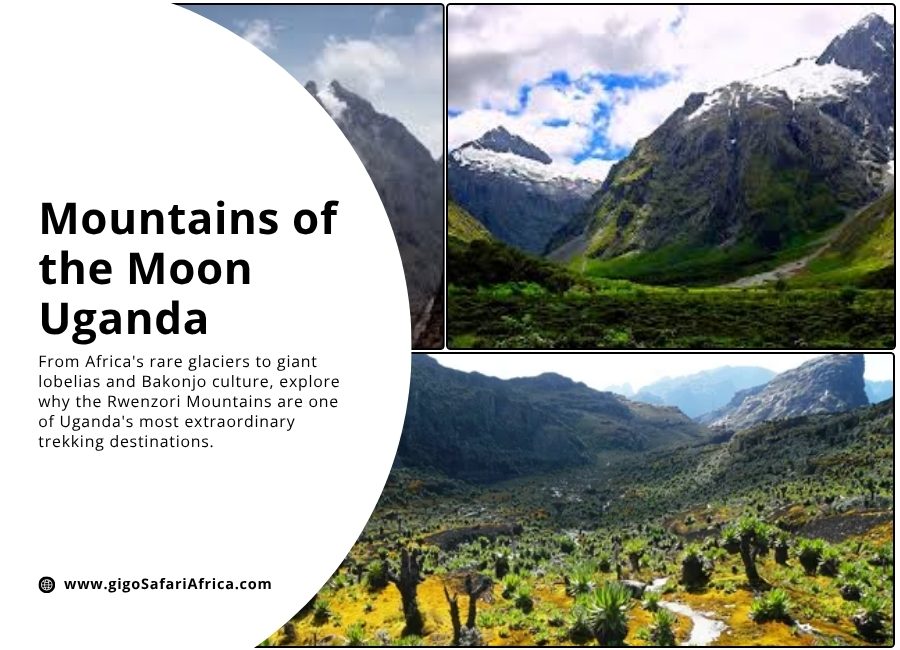
Ptolemy had never seen them himself. His conclusion was part observation, part traveler testimony, part reasoned deduction. What makes this remarkable is how close he came. The Rwenzori sit almost exactly on the Equator, where you would logically expect heat, jungle, and equatorial weather. Instead, explorers found glaciers, ice cliffs, and permanent snow.
The European explorer Henry Stanley officially placed the Rwenzoris on the world map on May 24, 1888, recording the name “Ruwenzori,”, which he documented as meaning “Rain-Maker” or “Cloud-King” in the local language.
The Bakonjo people, who have lived at the mountain’s foothills for centuries, called it “Rwenzori” or “Rain Mountains.” Their belief was that the mountains were home to their god, Kitasamba. The Baganda people had their own name: “Gambalagala,” meaning “my eyes hurt,” a reference to the distant snow dazzling in the equatorial sun.
Uganda Mountains of Moons Africa Are Not Volcanic, Not Ordinary
The Rwenzori Mountains carry a geological distinction that sets them apart from every other major African range. Unlike East Africa’s volcanic giants such as Kilimanjaro and Mount Elgon, the Rwenzoris were formed by tectonic activity, massive rock blocks thrust upward from the Western Rift Valley floor.
The mountains straddle the border of Uganda and the Democratic Republic of the Congo and lie along the western arm of the East African Rift Valley. In this area, tectonic plates are pulling apart, causing some blocks of land to fall while others, including the Rwenzori, rise.
The park covers nearly 100,000 hectares in western Uganda and comprises the main part of the Rwenzori mountain chain. Having Africa’s third-highest peak at 5,109 m, the park includes a much larger alpine area than either Kilimanjaro or Mount Kenya, with 70% of its terrain lying above 2,500 m.
Five Worlds Stacked on One Mountain
What makes the Rwenzori ecologically unlike any other African range is its vertical layering. The ascent from foothills to summit is not a single landscape; it is five distinct ecosystems, each with its own climate logic, plant architecture, and resident fauna.
| Zone | Altitude | Key Species |
| Montane Forest | 1,500 – 2,500 m | Prunus africana, Carapa grandiflora, hardwoods, ferns, vines |
| Bamboo Zone | 2,500 – 2,800 m | Arundinaria alpina (African bamboo), Hagenia abyssinica |
| Heather-Rapanea Zone | 2,800 – 3,200 m | Erica arborea (10 m tree heathers), orchids, Impatiens spp. |
| Afro-Alpine Moorland | 3,200 – 4,500 m | Giant lobelias, giant groundsels (Dendrosenecio), everlastings |
| Nival Zone | 4,500 m+ | Mosses, lichens, small alpine flowering plants, glacier ice |
The higher altitude zones, covered by heath and Afro-alpine moorland, extend from around 3,500 m to the snow line and represent the rarest vegetation types on the African continent.
Lobelia wollastonii, the giant lobelia, grows in the Afroalpine zone to heights of four to five meters and occasionally more. It is a monocarpic plant — it lives for years, sometimes decades, as a ground-hugging rosette before sending up its extraordinary flower spike once and dying.
Giant groundsels (Dendrosenecio adnivalis) stand in clusters, their shaggy leaves protecting them from freezing nights. Tree heathers, twisted and moss-covered, add to the landscape’s otherworldly character. Walking through this zone, many visitors describe a sensation of leaving Africa entirely, entering something older, quieter, and harder to name.
Wildlife: Endemic and Elusive
The park is home to over 70 mammal species, 217 bird species, 18 species of note, 9 species of reptiles, and 6 species of amphibians. The range has been recognized internationally as an Important Bird Area, and its bird count is expected to grow as survey work continues in less-accessible zones.
Two mammals are endemic to the range: the Rwenzori climbing mouse and the Rwenzori red duiker. Of the 241 known bird species, 19 are endemic to the range. The Rwenzori turaco, with its vivid plumage, is among the most sought-after by birdwatchers visiting the park.
At the lower altitudes, Rwenzori red duikers can be spotted staring from dense thickets of papery silver everlasting flowers. Higher up, chimpanzees, colobus monkeys, and olive baboons inhabit the montane forest belt.
The Nile Connection
Ptolemy’s ancient claim that the Rwenzori fed the Nile turned out to carry substantial truth. The Rwenzori Mountains are the highest and most permanent sources of the River Nile, constituting a vital water catchment for the region.
Their glaciers, wetlands, and high-altitude bogs slowly release water into river systems that drain eventually into Lake Albert and onward into the Nile watershed. The combination of spectacular snow-capped peaks, glaciers, V-shaped valleys, fast-flowing rivers with waterfalls, clear blue lakes, and unique flora contributes to the area’s exceptional natural and scientific value.
The Bakonjo: People of the Mountain
The Rwenzori Mountains hold deep cultural value for the Bakonjo and Bamba communities. These native communities have woven intricate myths, stories, and traditions around these peaks, making them a vital part of their historical and cultural heritage.
The Bakonjo people not only call these mountains home but also associate religious meaning with them. “Rwenzori” literally means “rainmaker,” and these mountains’ ability to bring heavy rains allows them to sustain agricultural life. The Bakonjo serve as the primary guides for climbers ascending the range.
Trekking fees and permits channel financial support to the Uganda Wildlife Authority through anti-poaching patrols, habitat monitoring, and a revenue-sharing program for the local Bakonjo communities. Booking local guides and porters, visitors also provide a sustainable economic alternative to activities that would adversely affect the mountain’s delicate ecosystems.
The Glaciers Are Retreating
Scientists estimate the Rwenzori glaciers could disappear entirely within the next few decades, a challenge that has heightened conservation urgency across the region.
Local Bakonjo guide Baluku Josephat, who has guided climbers through the range since 1982, has witnessed the consequences firsthand. Referring to Mount Baker, where glaciers have already melted entirely, he noted that people now walk over bare rocks where crampons were once essential.
The impacts extend beyond the snow zone. Chameleons have been spotted moving upslope. Trees are withering faster than expected, and as they die, moss and plant species dependent on them are likely to suffer in sequence.
The glaciers also hold a scientific record that cannot be replaced. Inside the Rwenzori’s receding glaciers are specks of pollen and dust that could unlock secrets about past climatic upheavals on the African continent. Once the ice is gone, that archive is gone with it.
Trekking the Rwenzori
The Rwenzori is not a mountain for casual walkers. The wettest months run from March to May and August to December, with some monthly averages reaching 19 inches of rainfall. Thickly vegetated rock slopes and deep mud in high-altitude bogs pose serious obstacles even in the supposedly dry season.
Ready to trek Africa’s most unique mountain range? Speak with Gigo Safari Africa today for permits, trekking logistics, accommodation, and customized Rwenzori trekking packages.
The Central Circuit Trail is the primary multi-day route, passing through all five vegetation zones. Most trekkers complete it in seven to nine days. The reward is encountering every landscape, tropical rainforest, bamboo stands, mossy heather forest, giant lobelia moorland, and finally the ice and rock of the summit zone.
The Rwenzori Cultural Trail also includes village visits, allowing travelers to interact with Bakonjo and Bamba communities and engage directly with the mountain’s living cultural traditions.
The park is managed by the Uganda Wildlife Authority. Entry requires permits, and all trekkers must use registered local guides, a policy that protects both visitors and the ecosystem.

Recent Posts
Mgahinga Gorilla National Park
Rwenzori Mountains Uganda: The Mountains of the Moon

The Shoebill Stork in Uganda: A Bird Watcher’s Complete Tour Guide

